Saturday, January 23, 2021

January Meeting: The Six Napoleons


Last Saturday was a busy one for those with Zooms attuned to catch the distant view-halloo.  To avoid conflict with the Baker Street Irregular Birthday Weekend, we moved our meeting back to the third Saturday of the month which had us overlapping with meetings in Baltimore, Nashville, and London, so there were lots of folks in and out.  

If you aren't on the Parallel Case's email list, you can send us an email at parallelcasestl @ gmail DOT com to get added to the list for meeting announcements and blog posts.

You can also follow our Facebook page for Sherlockian news.

Parallel Case of St. Louis pins are available!  You can email Joe to add to your Sherlockian collection.


Michael shared an Etsy listing where you can buy a bust of Napoleon made out of chocolate.

The Baker Street Irregulars have released their 2021 titles, The Staunton Tragedy, Corporals, Colonels, and Commissionaires, and A Quiet Air of Mastery.

The Beacon Society's Joel Senter Essay Contest is currently going on and open to any students between fourth and twelfth grades.  Entries are due by March 1.

Randy gave a great recap of the BSI Birthday Weekend.

And Bill has a great article on our blog looking at the importance of the number FOUR (not six) in this story.


SIXN starts off with Lestrade spending an evening hanging out with Holmes and Watson in Baker Street.  Rob noted that their friendship has really developed by this time, as the three men are just sitting around whiling the evening away until Holmes asks what Lestrade has on his mind.

"Oh no, Mr. Holmes, nothing very particular."

"Then tell me about it."

Lestrade says his matter may actually be more for Watson than Holmes, a type of madness.  Someone has broken three identical busts of Napoleon around London.  Watson agrees with Lestrade that it could be monomania, but Holmes is interested in the fact that all three of the broken busts came from the same mold.


Holmes says that even though it seems trifling, some of his best cases started out small, like the Abernetty business, which hinged on the depth that the parsley had sunk into the butter on a hot day.

We kicked around some other recorded cases that started out as trifles but ended up more serious and came up with BLUE, COPP, STOC, SOLI, REDC, and LADY.


The next morning, Lestrade telegrams Holmes as there's been a development.  Holmes and Watson travel to the home of Horace Harker of the Central Press Syndicate, where not only has another bust of Napoleon been stolen, but a murder was committed on his doorstep!  

While they are looking over the dead man and the photograph he was carrying, the bust has been discovered down the street, smashed.  Holmes deduces that it was smashed in that specific spot because of the lamp that would give the thief light to see what he was doing.


We get to see Holmes toying with Lestrade as they discuss their ideas on how to follow matters up:

Lestrade: I'd ID the dead man and look into his acquaintances.

Holmes: I'd do it a different way.

Lestrade: Really?  How?

Holmes: Never mind, I'm not telling you.

After this, Lestrade lets Holmes keep the photograph that the dead man was holding, which led Rob to wonder why such important evidence would be entrusted to a civilian, especially since it would help Lestrade with his line of inquiry.  Kevin said it was probably either because Lestrade trusted Holmes so much or Doyle didn't understand police procedures.

Holmes and Watson start tracking down the busts of Napoleon which takes them to Morse Hudson's shop.  He tells them that the busts came from Gelder and Company, and he recognizes the man in the photograph.  His name is Beppo, an Italian piece work man who had worked in his shop, but disappeared two days before the bust busting started.


They follow up with a visit to Gelder and Company, where the manager of the place also recognizes the photograph of Beppo, who used to work there until he was arrested for knifing a man about a year ago.  This was right around the time that the Napoleonic busts were being made.

At lunch, Holmes read's Horace Harker's newspaper report of the robbery and murder at his house, including the false information that Holmes and Lestrade purposely fed the reporter.  Holmes chuckles and says, "The press, Watson, is a most valuable institution if you only know how to use it."


And we have a few current and former members of the press in The Parallel Case of St. Louis who had some thoughts on this!  Adam said his history in journalism was that readers would often accuse them of inflating stories to justify their existence, the complete opposite of Harker's events.  Madeline said she gets irritated when Holmes is a jerk to people in the newspaper industry in these stories.

Srini wondered what immigration laws in England were during this time.  Michael shared a story of Marconi having a hard time entering England with his invention when customs officials thought it was a bomb.  Sandy cited an opposite example from the Canon where some Italians from America were let in and led to the events of The Red Circle.

Later on, Lestrade meets Holmes and Watson back at Baker Street and tells them that he has identified the dead man as Pietro Vanucci, "one of the greatest cut throats in London" and Lestrade assumes that the man was Mafia, meaning his murder was Mafia related.

Lestrade's comment coupled with the derivative descriptions of Beppo led us into a spirited debate on racism in this story.  Olivia is part of a non-Sherlockian reading group who'd also read SIXN recently, and they were much more bothered by the anti-Italian sentiments than she expected.  Stacey cited King George IV's divorce where he used the press to fan anti-Italian sentiment during the 1840's.  


Maureen felt that Beppo as a villain was a necessary evil for this story.  European travel was common and a working class man was needed to get the pearl into the bust.  Pernille told us that about 4,000 Italians had immigrated to England during this time, and a large number of them were plaster workers.  And Maureen reminded us that so many of Doyle's villains are described as ugly, or in a derogatory fashion.  Pernille supported that with the importance of phrenology during this time as well.  Brad noted that other criminals in the Canon are worse than Beppo, but most of them don't take nearly the verbal abuse that Beppo does.


Sandy reminded us that we were viewing this story through a modern day lens, and we should remember that this is a historical document.  Olivia pushed back that there were people during the Victorian period who would not have spoken this way about Italians.  Michael said that we still have our biases today and society still has racism.  

Josh gave us a great recap of colonial travel during this time, especially in his background of musical history.  He also shared an article on the history of Italian immigration to England in the Victorian Era.  This led to Rob citing an article from The Napoleon Bust Business Again that discussed all of the important contributions to British society from Italian immigrants during that time.

Back in our story, Lestrade has decided that he's got the case as good as solved, until Holmes asks him what role the busts play in his theory.  "You never can get those busts out of your head," he replies.  Rob noted that by the time SIXN is taking place, Holmes and Lestrade have known each other for at least 20 years.  By now, Lestrade should know that if Holmes is interested in a small aspect, it's important.  But time and time again, the inspector blows right past Holmes's ideas!  Some people never learn.

But Lestrade is determined to go to the Italian Quarter that evening to ask around about Venucci and Beppo.  He says he will go with Officer Hill, who knows the area well.  For those of us around St. Louis, "Hill" is almost synonymous with "Italian" as St. Louis's Italian neighborhood is named The Hill!  Michael wondered if our neighborhood was named after this character.


Holmes convinces Lestrade to wait until tomorrow and accompany him to Chiswick that night.  After sending a telegram, Holmes spends the rest of the evening rummaging through old newspapers in the lumber room while Watson and Lestrade hang out in the sitting room.  Rob wondered if it was safe for such a smoker as Holmes to keep a room full of old newspapers in his house.  Quite the fire hazard!


After a stakeout in Chiswick, Holmes, Lestrade, and Watson catch Beppo leaving a house with a Napoleon bust.  In fact, his knife still has Venucci's blood on it! (Ew, gross)


The next evening, Lestrade visits Baker Street again right before a Mr. Sandeford arrives to sell his Napoleon bust to Holmes as they had arranged.  After the man leaves, Holmes breaks the bust with his riding crop and pulls out "a round dark object fixed like a plum in a pudding," the black pearl of the Borgias!

We broke from the canonical story to all remember and appreciate Jeremy Brett's masterful performance of this scene where he pulled the table cloth off of the table...
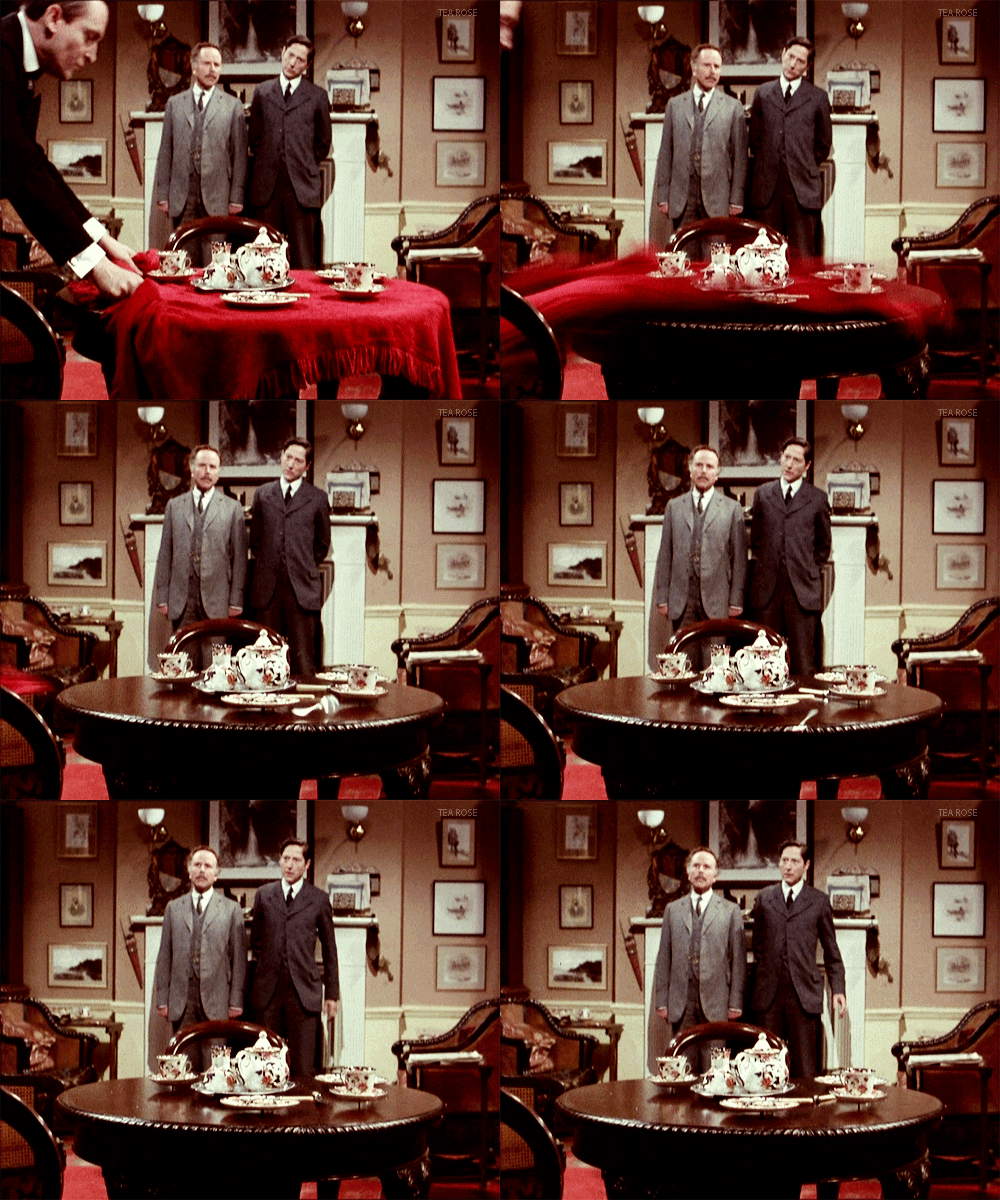

Stacey gave us some background on the Borgia family, citing they were a very dramatic family.  They had strong connections to the papacy and inspired at least one famous opera.  She also noted that pearls, black pearls specifically, had strong ties to royalty.  Maureen cited that Italy's location would have made it a natural point for black pearls to enter Europe from their natural location of the Pacific Ocean.

Watson and Lestrade applaud Holmes once he's told them the whole story.  Watson records Holmes's reaction: "It was at such moments that for an instant he ceased to be a reasoning machine, and betrayed his human love for admiration and applause."


The pearl had been stolen from the hotel room of the Prince of Colonna about a year ago (side note: if you have a jewel in a hotel room in Victorian London, you're probably going to end up in a Sherlock Holmes story).  The maid was suspected, who was the sister of Pietro Vanucci.  Two days after the theft, Beppo was arrested, but not before he was able to sneak into Gelder and Company and formed the stolen pearl into a Napoleonic bust that was being molded that day.  

Stacey said she couldn't decide if putting the pearl in the bust was brilliant or stupid.  Pernille said it was probably circumstance that dictated his actions, as Beppo was being chased by the police.  Steve argued that Beppo probably would've gotten away with crime if Holmes had not been involved, so it was a pretty smart move.  Stacey thought Beppo was so unlucky.  The odds were four (or five) out of six that he would have gotten the pearl before Holmes did and he still ended up losing it!


Andrew, David, Steve, Pernille, and Sandy discussed the inflation of how much one of the Napoleon busts would sell for today, and Holmes's offer to Sandeford would be quite a sum!

The story ends with Holmes telling Watson to "Put the pearl in the safe."  We can only assume that it was stored right next to the blue carbuncle.

Although monthly meetings were a lot of fun in 2020, we are returning to our bi-monthly schedule.  So please plan to join us via Zoom on March 13 for The Three Students.  Zoom at once if convenient!

Tuesday, January 19, 2021

The Fourth Napoleon by William R. Cochran


What a strange chain of events takes place in “The Six Napoleons,” leading to Holmes taking possession of the stolen Borgia pearl. Lestrade seems to serve as narrator in many of the incidents, as he does not call upon Holmes until after the third bust is destroyed. Lestrade’s initial reaction to the first bust in the shop was to surmise that “The plaster cast was not worth more than a few shillings, and the whole affair appeared to be too childish for any particular investigation.” However, when the second victim, Dr. Barnicott, is burgled twice in the same night, Lestrade sees it as a serious crime and then comes to Holmes for assistance. One may well ponder why Lestrade finds the bust worth only a few shillings should now be considered a serious crime. 


The third instance, where the forth Napoleon is smashed, murder is involved. Although the murder takes place in a journalist’s home, Mr. Horace Harker, of the Central Press Syndicate, is quite put out that he did not get the story to press. The murder aside, it is interesting, as the fourth Napoleon was purchased “four months ago.” Could this coupling of fours possibly refer to a month– April? Note that the smashed bust is discovered “in the front garden of an empty house in Campden House Road.” Watson and Holmes held a vigil in “Camden House” in order to capture Colonel Moran. Ten years later, this story is published and Watson finds himself on Campden House Road. Moreover, even Sherlock Holmes draws attention to the empty house. 


One of the interesting elements of Lestrade’s account is that the bumbling detectives should find the plaster fragments and know that they were from this particular bust of Napoleon.  The Inspector is puzzled when Holmes draws his attention “ very particularly to the position of this house in the garden of which the bust was destroyed.”  


Lestrade looked about him. 


“It was an empty house, and so he knew that he would not be disturbed in the garden.” “Yes, but there is another empty house farther up the street which he must have passed before he came to this one. Why did he not break it there, since it is evident that every yard that he carried it increased the risk of someone meeting him?” 


“I give it up,” said Lestrade. 


Holmes pointed to the street lamp above our heads. 


“He could see what he was doing here and he could not be there. That was his reason.” Therefore it is clear that Lestrade is sticking to his theory that the busts are being smashed by someone who harbors a strong dislike of the “Little Corporal.” However, if the madman must see the pieces, it is clear that something is in the bust he is seeking. 


The fifth bust adds fodder to the theory that this case identifies Holmes’s date of birth. If the month was the fourth, could this fifth bust possibly indicate the fifth day. Note that as Holmes and Watson depart to Chiswick, Watson “was not surprised when Holmes suggested that I should take my revolver with me. He had himself picked up the loaded hunting-crop which was his favourite weapon.” They are about to lie in wait in the dark, hoping to snare the man who has expended so much energy breaking busts of Napoleon. How many times has Holmes referred to Professor Moriarty as “The Napoleon of Crime.” With Moriarty gone, Colonel Moran was captured in a similar manner in Camden House on 5th April 1894. As they head for their destination that fateful night in 1894, Watson remembers “It was indeed like old times when, at that hour, I found myself seated beside him in a hansom, my revolver in my pocket and the thrill of adventure in my heart.” And so it was as they headed to Chiswick the four wheeler—another reference to four. 


However, it is the sixth Napoleon that contains the Borgia Pearl. Since Lestrade is present as Holmes reveals the pearl in the sixth bust, why does the detective not take possession of the stolen pearl? True, Holmes went to great pains to ascertain that he owned the bust by having the good doctor sign a receipt. “You will kindly sign that paper, Mr. Sandeford, in the presence of these witnesses. It is simply to say that you transfer every possible right that you ever had in the bust to me.” It amazes me that Sanderford did not suspect the bust contained something of value when Holmes offered to pay almost ten times what had paid for it. Although it may well have made a rather mysterious jewel his for a moment, it is doubtful that Holmes will be allowed to keep the gem; and that he will return the pearl to its rightful owner.


Sunday, January 3, 2021

Some Further Thoughts on Private Revenge by John Keath

Some Further Thoughts on Private Revenge

By John Keath


Maybe it's just me or maybe it's coming back to the stories after so long an absence.  

What I get from the stories is not the same what got when I first read them as a teenager.  And what I look for now, is not what I looked for then, either.

I now look for the well-turned phrase that jumps out to me from the canon, which often encapsulates the story or some aspect of Holmes' extraordinary powers.

In this respect our most recent story, "The Adventure of Charles Augustus Milverton," does not disappoint:

"I think there are certain crimes," says Holmes in the second to last paragraph of the story, "which the law cannot touch, and which therefore, to some extent, justify private revenge." 

(Here, I should acknowledge the implications of this quotation for Rich's theory regarding the identity of the murderer in this case that he presented at our meeting.  But putting that it to one side, I find compelled to take Watson at his word as he presents the story.)

"Milverton" is perhaps not the most loved of the adventures.  It never made Conan Doyle's top 10 favorites list, or maybe anyone's.

But it well represents two of Doyle's most enduring contributions to the development of the genre of detective fiction. 


The first is the requirement that the story have a worthy adversary or villain.  The physical appearance of Milverton captured by Sydney Paget or Frederic Dorr Steele would be enough to impress him deeply into our consciousness.  (Even down to the astrakhan coat and the spectacles) 

It is hard to imagine a more fitting portrayal than Robert Hardy's performance in "The Master Blackmailer," (Granada, 1992).  (Could this same actor have also portrayed Winston Churchill?) 


But his manner--oh, his manner!  So reptilian and supercilious--bordering on the unctuous. So reprehensible and officious.  The universal response of almost everyone he comes in contact with is to recoil in moral outrage. 

In a word, oleaginous.

To be sure, Milverton seems more than equal to Holmes' challenges.  Their negotiation session yields no favorable resolution and Milverton leaves Baker Street ostensibly the winner "with a bow, a smile, and a twinkle." 


His curtained lair in isolated Appledore Towers features a a desk and red-leather turning chair, a tall green safe, and a large bookcase bearing a marble bust of Athena.  Every worthy villain must have a lair.  It only lacks a sign over the door saying "Abandoned all hope ye who enter here."  (Granada's CAM coach is also a nice touch).

So, Milverton certainly fills the bill of the requirement that a story have a true villain.  Even Lestrade agrees.

We now turn to the second requirement of a good detective story: that the mystery have a satisfying resolution.

To me, I find the shooting of Milverton befitting the ends of justice. We have spoken in our meetings of Holmes' special brand of justice, of when he will act and when he will not.  


In this case Holmes' "cold, strong grip upon [Watson's] wrist" makes clear his sentiments and intent as the murderess pumps bullet after bullet into Milverton's "shrinking body."  No tears are shed over his demise.

If there be justifiable homicide, let this be one.

Further, Watson's concepts of morality are likewise unchallenged by the course of events.  He states simply "justice had overtaken a villain."

So what of the witness?

What witness, you ask?


Have you forgotten the silent, omniscient marble bust of Athena?

This bothered me a little bit at first.  The Master Blackmailer took this aspect in an interesting direction in its extrapolations of the story, but I was not completely convinced.  So I did some research and found a different answer that seems to me to make some additional sense.   

I was curious about Athena, so I checked and learned that the Greeks viewed her as the goddess of wisdom, warfare, and other things.  Among her various symbols, I found snakes.  Suddenly it fits.  That Milverton would operate under her gaze seemed apropos.  

Holmes acted so coolly in the immediate wake of the shooting, without hesitation, but with sure dispatch, consigning venomous letters to the fire.   Their power reduced to ashes, they would cause no further injury.   

And in the final sense, Isn't it a fitting resolution that this comes as an offering at the altar of Athena?   And that a man who despicably dealt in the secrets of others dies at the hands of ever-secret avenger(s) before the silent god of his own creation and destruction?

A private revenge.  

Thursday, December 31, 2020

2020: An Unparalleled Year

2019 saw The Parallel Case of St. Louis outgrowing our old meeting space at a local branch of the St. Louis Public Library.  So we moved to a larger meeting room at The Ethical Society of St. Louis, a place that we'd hosted a few movie nights at previously and we had big plans for this year.

We met there once.

As a scion that met every other month, we got our January meeting in with attendance continuing to grow from month-to-month, and we were looking to continue that trend at the March meeting.  Well...... we didn't know exactly what this new Covid-19 illness was or how long things would be on hold, so we postponed the meeting, hoping to get together in April.  Everyone knows how the Covid thing went, so like many Sherlockian groups, we moved our meetings to Zoom, deciding that meeting via screens was better than not meeting at all.

As the year continued, our meetings were so popular, that we DOUBLED our meeting regularity and were quickly welcoming folks from other states and other countries to our story discussions!  Just like many other scions, we soon learned how great it was to fling open the doors and welcome anyone interested, no matter where they lived or how many meetings they'd previously attended (I've very proud to say The Parallel Case of St. Louis has been the first Sherlockian meeting for a handful of new folks this year!)

If you missed our recap posts from each meeting, feel free to check them out below.  The discussions get into some great canonical points as well as non-sequiturs that crack everyone up!

January: The Final Problem

March/April: The Hound of the Baskervilles

May: The Empty House

July: The Norwood Builder

August: The Dancing Men

September: The Solitary Cyclist

October: The Priory School

November: Black Peter

December: Charles Augustus Milverton

But our thoughts on the Canon and Sherlockiana weren't contained to just meeting discussions!  2020 saw a huge influx of blog posts from members of the Parallel Case.  They ranged from a medical view of the Canon to how Ghostbusters is related to The Hound of the Baskervilles.  So many great thoughts were shared on the blog this year, and I'm already looking forward to what our members will come up with for 2021.  But before we move forward, a quick look back at some of the amazing scholarship form this year:

The Terror of the Hound of the Baskervilles by Heather Hinson

The Adventure of the Baffled Critic by William R. Cochran

Can We Trust the Canon? by Tom Crammond

Holmes, Heroic, Hiatus: A Man to Match the Swiss Mountains by Gordon Speck

A Short But Interesting Visit by Ed Moorman

The World View of Robert Downey Jr.'s Sherlock Holmes by Kevin Letts

Jonas Oldacre: Norwood Builder by Rich Krisciunas

What Gun Did Abe Slaney Use in the Adventure of the Dancing Men? by Michael W.

Scriptor Subpono: The Solitary Cyclist by Andrew Basford

Medical Musings from the Sherlock Holmes Canon by Srini Raghavan

The blog is always open to folks who would like to see their thoughts in print, so if you have an idea you'd like to write up please let us know!

On the down side, The Parallel Case of St. Louis was poised to host a second Holmes in the Heartland in 2020 with an impressive lineup of speakers, vendors, games, tours, and fun.  Although it wasn't safe for anyone to travel to St. Louis or for people to gather, we are too stubborn to completely cancel the event, so we are looking forward to everyone joining us in St. Louis NEXT summer, July 9-11, 2021.  And luckily, every single one of our speakers has committed to be there, so if you were excited about it, mark your calendars!

2020 has been quite a year, but the Parallel Case of St. Louis weathered the storm in admirable Sherlockian spirit.  If you'd like to join in, you can be added to our email list by contacting parallelcasestl @ gmail.com or following us on Facebook and Twitter.  And please join us at our next meeting on January 16 to discuss The Six Napoleons.  Zoom at once if convenient!


Monday, December 14, 2020

December Meeting: Charles Augustus Milverton

The Parallel Case of St. Louis started out this year moving to a new location, but when Covid 19 hit, we shifted to Zoom meetings like so many other Sherlockian groups around the world, and they proved to be so popular we moved to a monthly schedule for the remainder of the year.  We had participants from all over the country, as well as Canada, England, and France!  Although 2020 has been a tough one on everyone for many reasons, we in St. Louis were able to find some Sherlockian joy in meeting and discussing the stories that we love.


We will continue to have meetings via Zoom in 2021 until we feel that it is safe for our members to meet again in person.  We will, however, be going back to our bi-monthly schedule, with meetings in January, March, May, September, and November.  You may have noticed that July isn't on that list.  That's because Holmes in the Heartland is on the second Saturday of July, when we would normally host a meeting, and we couldn't imagine a better way to have our July meeting than to enjoy the great lineup of speakers that are slated for the event!

And our last meeting of 2020 was another fun one!  After welcoming and introductions, we got down to some Sherlockian news and events:

All of the events for the BSI Birthday Weekend in January are now open and the Friday night dinner is the only event listed that requires an invitation.  Everything else on the docket is open to anyone interested, and there are a LOT of chances to visit with and listen to some great Sherlockians speak (without having to pay for airfare and hotel!).  We are encouraging everyone to check out at least one Birthday Weekend event in January, and have in fact moved our January meeting  back a week so that there is no conflict for any Parallel Case members who want to participate in the festivities.

Presentations from the Left Coast Sherlockian Symposium are now available for viewing on their website.

Rebecca Romney gave the 2020 Cameron Hollyer Memorial Lecture at the Toronto Public Library, sponsored by the Friends of Arthur Conan Doyle Collection.  Her talk was on Sherlockian collecting and anyone who has picked up a few items of Sherlockiana here and there can definitely relate to her topic!

Steve told everyone about the current projects being hosted by the Beacon Society, supporting efforts to introduce Sherlock Holmes to young people.  Educators can apply for the Jan Stauber Grant of up to $750 to support their endeavors with Holmes, the R. Joel Senter Essay Contest awards students up to $300 for their essays about the Great Detective, the new newsletter Sherlock's Spotlight Gazette is specifically targeted to fourth to sixth graders who may be interested in Sherlock Holmes, and the Fortescue Quiz is available for Sherlockians of any age wanting to test their knowledge of the Canon.  Details for all of these projects and more can be found on the Beacon Society website.  

Elaine shared her stamps and postcards she ordered from the British postal service from BBC Sherlock.

Opera Theater St. Louis will be hosting a virtual performance of Pirates of Penzance along with a premiere party, Pirates and Pancakes, on January 23.   

Madeline has a fun cartoon series reimagining Moriarty and Moran's working relationship.  

The Sherlock Holmes on Screens discussion group on Facebook has posted some incredible finds recently.                

The Shaw Festival in Niagara on the Lake will be staging Sherlock Holmes and the Raven's Curse next summer.  Nancy reports that they've done Sherlockian shows many times before and they've always been worth seeing.

Joe announced that Parallel Case of St. Louis pins are available for sale.  Pins are $10 each plush shipping and handling.  You can email Joe at jeckrich @ sbcglobal.net but know that the pins will not be shipped until after the holidays.


And there were so many upcoming events!  You can definitely get your Sherlockian fix by checking these meetings out:

The Alkali Plainsmen met on Sunday

The Six Napoleons of Baltimore will meet this Monday, register here 

The Harpooners of the Sea Unicorn will meet on Friday, to observe the Feast of the Blue Carbuncle 

The Sherlockians of Baltimore will meet on Saturday, register here  

The Fourth Garrideb Facebook Live! 3GAR reading Fri. 12/25 8 pm EST


Rich gave a great presentation on who he thought was the murderer of Charles Augustus Milverton (look for that in an upcoming issue of The Sherlock Holmes Review).  But that led to quite a discussion on the blackmailer's murder.  

David liked Rich's theory, but Kevin pushed back by asking why Watson would have ever published this story if Rich were correct.  Bruce cited the Paget illustration to support this argument.  Edith said that no matter the outcome, we are still debating this case over a hundred years later.

Cindy said that the murderess was one of her favorite characters in the Canon.  John G cited Granada's version for her motivation.  Stacey theorized that the murderess was Princess Beatrice, whose husband had created court gossip with his behavior towards Beatrice's sister and Agatha was her accomplice.  But Baronne wondered if a servant would be willing to lose her position by allowing her employer to be killed.  

Rob cited research that offered Lady Rothschild as being the murderess.  Nancy knew of the family and their connection to the Royal Family and Stacey said Lady Rothschild would have been alive at the correct time, but her husband's death didn't line up.  Michael had a suspect, but was willing to say her name as she has famous living descendants.  He also thought it was connected to the Prince of Wales's paramours at the Langham Hotel.


Nancy questioned where this story falls in the chronology, wondering if Holmes would have still been alive when it was published.  Rob cited chronologists that place this story early in Holmes's career due to Watson's reticence at breaking in and Cindy and Steve said they would have had to have been fairly young to jump that wall and run two miles.  Brad and Howard thought that this would have taken place in 1891 and that Milverton was associated with Moriarty.

Nancy also wanted to know why Watson would own tennis shoes.  Rob thought the tennis shoes would have looked out of place with his theater-going outfit and Steve figured that Watson was being sponsored by Nike.  


Rob wanted to know where the guard dog was during Holmes and Watson's escape.  John G said that Agatha routinely put the dog up so Escott could visit and David said that the dog was so familiar with Holmes that it did nothing in the night-time.

As we talked about the layout of Appledore Towers, Rob showed The Milvertonians of Hampstead and a picture of what they had decided was Appledore Towers, which is called The Logs in real life.  Josh is interested in the old houses of Hampstead, and said that The Logs is owned by Boy George today!  He shared a website where you can actually see the wall that Holmes and Watson scaled.


Another book was discussed that went well with this story, The Worst Man in London.  We talked for a few minutes about an essay in this book about the real life inspiration for Milverton, Charles Augustus Howell, a truly despicable person.

Rob said he felt that Holmes was working the complete opposite of a blackmail case here as he did in A Scandal in Bohemia.  Olivia and Madeline argued that the King of Bohemia wasn't truly being blackmailed.

Bruce offered that Milverton was actually an honest businessman, even if people didn't like what he was selling.  David agreed with that and wondered if that's why Holmes had such a visceral reaction to him.

This led to a group discussion of how much everyone hated Milverton.  The word "slimy" was used VERY often!  David compared Milverton to Moriarty in the way that they were both unrepentant and would not stop unless Holmes stopped them.


And speaking of moral choices, we moved to how Holmes treated Agatha in this story.  Olivia offered that Holmes viewed his behavior as acceptable because Agatha already had another suitor waiting in the wings.  John G said that it was a class issue and it was evident that Watson was happy for the engagement until he found out that it was to a maid.  Nancy found it interesting that Watson congratulated him at first instead of being surprised.  

Steve said that once you start going down the road of believing that Watson lies (like many of us were willing to go along with when it came to the murderess), then maybe Watson made up the whole engagement story, too!  Rob said that Holmes was doing the same thing to Agatha that made him so angry when it was done to Mary Sutherland in IDEN.

David said that this was an ends justify the means situation.  Olivia and Madeline said Holmes's actions were reminiscent of his behavior towards Watson in The Dying Detective.  

Rob cited a passage from Brad Keefauver's book, Sherlock Holmes and the Ladies, where Brad posited that the engagement was Agatha's agenda.  Brad still stands by his thoughts, even decades after he first wrote it, saying Holmes took advantage of a situation that was available.


....and that led Nancy to ask how much "advantage" Holmes took of Agatha?

Olivia said she hoped Holmes would have stayed a gentleman.  Andrew had a classic bon mot about a plumber and Elaine pointed out that Holmes knew where everything was in the house, which meant she must have let him in the house more than once.  Rob pointed out that Holmes said that his courtship included long walks, although just a few days later Watson reports it as being bitterly cold.  How much time could they have spent outside?  David cited Holmes as saying, "I got all I wanted."  

Changing the topic before things got too graphic, Rob recited the exchange between Holmes and Watson:

“You are not coming.”

“Then you are not going."

Olivia said that no adaptation of this story has ever captured this exchange.  But apparently, Randy's wife is good at delivering Watson's line.  

Rob also enjoyed the line, "You know, Watson, I don’t mind confessing to you that I have always had an idea that I would have made a highly efficient criminal."  Someone should write a book about that.

Elaine said she thought that Milverton's bust of Athena in the study was foreshadowing that he would be taken down by a formidable woman.  And Cindy thought that Milverton was baiting the woman that eventually shot him.

Holmes and Watson escaped the scene of the crime and ran two miles.  Rob said that was quite a feat for a wounded war veteran.  John said that the wound was in his shoulder so it wouldn't have mattered, and Andrew said this path should be renamed the Milverton Marathon.

Lestrade shows up at Baker Street the next morning, asking for Holmes's help catching the criminals.  Lestrade describes one of the criminals as "...." This is the only full description in the entire Canon that readers get of John Watson.

Srini wondered if Lestrade actually suspected Watson, and pointed out that the force didn't seem to work too hard to find their suspects after Holmes rebuffed him.  Kevin wondered if Holmes's visits as Escott were observed while Scotland Yard had Milverton under observation.

Olivia, David, Rob, and Rich went back and forth on the statute of limitations on Holmes and Watson's crimes and if publishing this story was a smart idea.  It sure was smarter than trying to take out an armed blackmailer with a chair!

We could've kept going and going, but we were coming up on the two hour mark.  So it was time to call it a day and wrap up our discussions for 2020.  But you can join us on January 16, for our discussion on The Six Napoleons.  Zoom at once if convenient!

Wednesday, November 25, 2020

November Meeting: Black Peter

Dozens of Sherlockians from across America, Canada, and France joined in for this month's discussion on The Adventure of Black Peter.  After some general chitchat and introductions, we jumped in to the little bit of news there was to discuss:

We talked about the Sherlockian Saturday at the Pratt event that happened a few hours before our meeting.  Plenty of our members and attendees were at the Pratt event and everyone agreed that it was full of great presentations.

Srini wrote a wonderful blog post for us about looking at the Canon through a physician's eye.

The Beacon Society just started a gazette for kids in fourth through sixth grade and is definitely worth checking out.

Mike announced that backers for Sherlock Holmes and his Baker Street Irregulars should be receiving their copies soon.  Anyone who wasn't able to get in on the Kickstarter can still order the game at a discounted price.

We talked about Brad's podcast, Sherlock Holmes Is Real, and how it argues that the Ronald Howard series was documentary evidence of Sherlock Holmes's real life. 

A few book recommendations were tossed out:

Srini liked House of Silk by Anthony Horowitz

Heather recommended Villains, Victims, and Violets edited by Tamara Bower and Resa Haile 

Rob recommended More Leaves from the Copper Beeches edited by H.W. Starr

And then it was time to get down to business!

Our story starts off with Watson telling us that 1895 was a busy year for Holmes, with the death of Cardinal Tosca and the case of Wilson the notorious canary trainer.  Rob told of a story he heard when a Sherlockian attended the Gasfitters' Costume Ball during Autumn in Baker Street.  The man was wearing a St. Louis Cardinals jersey with Tosca on the back: Cardinal Tosca! 

Wilson, the notorious canary trainer has had plenty of interpretations as well. Nicholas Meyer adapted this story, which many people remembered fondly.  We talked if the word "canary" was meant to describe birds or criminals.  

Watson says that Holmes was busy that July, but hadn't included him yet in the case.  He knew that Holmes was at work because sailors kept reporting to 221B looking for Captain Basil.  Plenty of us had THIS Captain Basil in mind when we read that:

Holmes comes home one morning carrying a harpoon (which is such a great image!), leading to quite the exchange with his roommate:

Holmes: You'll never guess what I've been up to

Watson: I'm not even going to try

Holmes: I've been trying to stab a pig

Watson: Of course you have

David told us that the game Sherlock Holmes: Crimes and Punishments had Black Peter as a playable case where you had to practice harpooning pigs as part of the case.

Stanley Hopkins soon arrives for one of his four appearances in the Canon.  Rob noted that all of Hopkins's appearances occur during The Return.  Hopkins fills Watson in on the case, telling him that they are investigating the murder of a whaling ship captain named Peter Carey.  Carey had been murdered by a harpoon through the chest, "pinned like a beetle on a card."

Randy asked if Peter Carey's body was up off of the ground when he was harpooned to the wall or if he would have been slouched.  Either way, it would have been gruesome.  Joe thought that we should turn this into a part of game night for Holmes in the Heartland.

Hopkins pleads for Holmes to come help, saying, "It's my first big chance."  Holmes agrees to help and they head out.  When they arrive, they find marks showing that someone has tried to break in via the door and the window.  Holmes expects this visitor to return.

After investigating the murder scene, Holmes and Watson take a break and walk through the woods for a few hours before they expect the suspect to return.  Rob pointed out that Holmes appreciated nature, but Randy argued that Watson is quoted as saying Holmes had no room in his life for nature in CARD.  Kevin countered that Holmes showed attention to the moss rose in NAVA, which led to a small discussion on the purpose of that monologue.  Edith and John thought Holmes was covering something up with his digression, while Olivia saw it as genuine.  This conversation somehow led to the Cottingley fairies and Arthur Conan Doyle dressed as Viking.

John got us back on task and said he found it odd that Carey was allowed to be as brutal to everyone in town but the local police never got involved.  He even got away with assaulting the local vicar!

Stacey said the description of Carey's wife and daughter saying they were glad he was dead was heartbreaking.  Elaine said it was a wonder he found anyone willing to marry him in the first place.  

We all agreed that no one cared that Carey was dead and wasn't concerned with the murderer being brought to justice.  Olivia thought this case would have been one where Holmes would have let the villain escape if Hopkins hadn't been present.  Kevin found this very similar to Grimesby Roylott's death in SPEC and Heather expected us to have the same conversation next month with CHAS.

David said Black Peter is similar to ABBE because Holmes is less interested in catching a murderer than he is in clearing the innocent man that had been arrested.  John pointed out that the killer in this story had already covered up one murder, so Holmes may not have been so lenient with him as he was in other stories.

Rob cited Doyle's description of the vigil which led to everyone listing off all of the many, many times where Holmes and Watson are waiting and watching.  Steve thought having a Harry Potter invisibility cloak would have made these stakeouts much easier.  Olivia thought the name "The Thirsty Beasts of Prey" would make for a great name of a drinking group.

John Nelligan, a shrimpy little 20 year-old shows up and starts looking through Carey's stuff before Hopkins arrests him. Stacey thought Nelligan's outfit was hilarious and showed us examples of the styles described.  Nancy and Susan pointed out that his cover story was that he was staying in town for golfing, but Joe wondered why he would be wearing that at 2 am.

Hopkins tells Holmes that he would have brought the case to a successful close without him, and Rob asked everyone if they thought that was true.  Elaine pointed out that Hopkins wouldn't have thought to do a stakeout.  Susan said if this story was going to be published by the Strand, Holmes had better have been useful!


The next morning, Holmes invites Hopkins to Baker Street to discuss the status of the investigation because he thinks Nelligan is innocent.  Elaine found it so sad that Hopkins was happy to throw someone in jail, even with Holmes pointing out all of the problems with his case.  Stacey said Hopkins was probably just acting as the fashion police.  Srini was interested that Holmes always had high hopes for Hopkins.  John pointed out that Holmes didn't suffer fools, but Nancy countered that he often spoke harshly to Watson, so maybe the comments were meant to help develop his skill.


Three sailors soon arrive to interview for a harpooning position with "Captain Basil."  One of them is named Patrick Cairns, and Holmes asks the man to sign a contract.  When he bends over, Holmes handcuffs him and a fight quickly breaks out.  Watson said that Patrick Cairns would have overpowered Holmes if he and Hopkins hadn't intervened.  Rob wondered if this is the only time in the Canon that Holmes is outmatched in a one-on-one battle.  Srini made an argument for Jefferson Hope, and Olivia thought about Sebastian Moran.


Cairns admits that he killed Peter Carey, but did not murder him.  He killed Black Peter in self-defense.  Rob said the reason Peter Carey died is because he brought a knife to a harpoon fight.

Srini wondered why Cairns wouldn't have been willing to try and sell the securities.  Was he expecting to just find cash in the stolen box?


Stacey talked about her parents taking she and her sister to a whaling museum as a teenager and she hated how graphic the pictures and displays were.  Olivia pointed out that Doyle almost died numerous times on his whaling voyage.  Andy wondered if the safety procedures on the ship would earn a SEAL of approval?

The case is closed, and Holmes tells Hopkins that if the police need him, he and Watson will be in Norway.  Why Norway?  

Olivia thought they were going to investigate narwhal attacks and David said it was to see the fjords.  Elaine cited the Klinger Annotated and said that they were hunting down the lost securities but Joe pointed out that Nelligan's father never made it to Norway.  Brad said maybe Holmes and Watson knew something else of value was there.  John wondered if this trip led to the development of a certain Norwegian named Sigerson.  Stacey thought planning a fake whaling expedition just made Holmes want to go somewhere cold.  And Elaine said he could practice his harpooning skills there.  Nancy posited that there was still something in Norway that would help the Nelligan pay off his debts.  No matter what we said, we were having a hard time making a connection to Norway.  But we did piece together this little tune:

Someday we'll find it, the Norway Connection

The blubbers, the dreamers and me


Our next meeting will be on December 12 to talk about Charles Augustus Milverton.  Zoom at once if convenient!


Saturday, November 14, 2020

Medical Musings from the Sherlock Holmes Canon by Srini Raghavan

“When you have eliminated the impossible, whatever remains, however improbable, must be the truth." [SIGN]

These are some of the immortal words uttered by Sherlock Holmes, over the course of his illustrious career in the story of The Sign of the Four.  Supposedly Arthur Conan Doyle’s inspiration for this was taken from his medical training where one is taught to list all the possible diagnoses for a given condition, and try to eliminate those one after the other based on clinical parameters.  


I think one could parse these words a bit, especially the word impossible, but that would be for another day!  I've picked out a few medical oddities along the Canonical journey for your consideration.


In the Speckled Band, Dr. Roylott’s death was caused by an Indian snake and he supposedly died within 10 seconds. 


There are two major types of venom: the hemotoxic and the neurotoxic . While the neurotoxic acts by paralysis of the respiratory muscle and the hemotoxic acts by clotting the blood within the circulation, neither of them will kill in 10 seconds.  It will take many minutes at its fastest, and usually slower than that. This particular snake was identified  to be a viper which produces a hemotoxic poison, which acts slower than a neurotoxin.


Apparently one Mr. Klauber (per Mr. Baring-Gould’s book) postulated that this snake could have been a hybrid of a Gila monster and a cobra, created by the Infamous Doctor Roylott, (a la Frankenstein) and thus capable of going fast up and down the bell-pull rope, and also having a very deadly bite!


This seems very far-fetched, but does allow Mr. Klauber  to give full reign to his imagination!


The more prosaic explanation is that Dr. Arthur Conan Doyle was just exercising a bit of poetic license.


In the Naval Treaty, after the valuable naval manuscript went missing , Mr. Percy Phelps reports that he was unconscious for 9 weeks with “brain fever" and before that he was “practically a raving lunatic"!


During Victorian times “brain fever” would encompass a lot of mental health states, and this sounded like a “nervous breakdown” but it is impossible for one to be unconscious for 9 weeks from it.


Interestingly, the modern day interpretation of brain fever could be stated as encephalitis, most commonly caused by viruses. St Louis has the dubious distinction of having one such virus named after it


Now, if one had a viral encephalitis, one could possibly be unconscious for a long period like the nine weeks mentioned in the story.  One interesting explanation could be that mental stress can decrease the body’s immune responses, and what if Mr. Phelps' stress actually made him susceptible to a viral encephalitis at that time? Just a thought as we will never know!


In the opening passage of The Priory School, Dr. Thorneycroft Huxtable entered their rooms at Baker Street and fell down and becomes “insensible."  Dr. Watson postulates it to be “absolute exhaustion - possibly mere hunger and fatigue."

His  face is described as “heavy white" with “leaden color.”  All these suggest that this gentleman actually had a vasovagal episode also known as a fainting spell!

This condition usually does not produce a thready pulse described, “where the stream of life trickled thin and small.” Usually it does produce a slowish and reasonably strong pulse and the diagnosis of a fainting spell is further reinforced by the fact that he “scrambled up in an instant." Travelling 6 hours on a train can't be that exhausting to cause one to faint.


All these are my views from the perspective of a health care provider and I do realize there can be other interpretations, but I did have fun putting my thoughts down, and I hope you all enjoy those as well.