Sunday, January 2, 2022

Katham by William Cochran

KATHAM1 

by William R. Cochran, BSI OEH 


“The Adventure of the Second Stain” has proven to be an enigma of the first order. It would seem that this narrative has more lives than Watson has wives — according to the dean of Sherlockian Scholars, H. W. Bell —who cites not one, nor two, but possibly three isolated mentions of the case in the Canon.2 No less a critic than Anthony Boucher relates Bell’s conundrum:  


“The Second Stain” of 1888 (mentioned in The Naval Treaty), involving Monsieur Dubuque, of the Paris police, and Fritz von Waldbaum, the well-known specialist of Danzig, is certainly not the story later told in full. But “The Second Stain” referred to in 1890 (in The Veiled Lodger) is quite possibly the published story. In this (H. W. Bell’s Second Stain I) ‘it chanced that even when [Holmes] erred the truth was still discovered,’ which is true of the published Second Stain if one views it from the aspect of the murder of Eduardo Lucas, which was solved by chance, quite without the efforts of Holmes.3 


It would seem that many critics believe this Canonical trinity were all were the same narrative.  Many point to the extreme security surrounding the actual case being at fault for the omission of these facts in the published account. 


To arrive at the truth, one must, first eliminate the impossible. It is mentioned in the canon in various forms 3 times. The first mention of the case is names the case, and appears to date the case based upon his mention of his marriage in “The Naval Treaty,” 1887-1889. However, since Watson was married more than once, one must ponder which one. 


THE July which immediately succeeded my marriage was made memorable by three cases of interest in which I had the privilege of being associated with Sherlock Holmes, and of studying his methods. I find them recorded in my notes under the headings of “The Adventure of the Second Stain,” “The Adventure of the Naval Treaty,” and “The Adventure of the Tired Captain.” The first of these, however, deals with interests of such importance, and implicates so many of the first families in the kingdom, that for many years it will be impossible to make it public. 


The pertinent data contained in this statement is that the month was July. If Watson is referring to his first marriage to Mary Morstan. The consensus of the chronologists would place the date as early 1887 and as late as 1889. This three year period mirrors the time spent on Hiatus from May 1891 to 05 April 1894. 


In regards to Mary Morstan, a perusal of 15 opinions about the dating of The Sign of Four, only Ernest Bloomfield Zeisler in his Baker Street Chronology lists a month for the case that would allow the Watsons to wed before July. Seven chronologists pick September; however, of the remaining opinions three select July or September, and only five select July. The arguments presented by the chronologists would fill volumes, and never reach a consensus opinion. Therefore, because the decided majority have selected September, it would seem that because “The Naval Treaty” states the case succeeded his marriage, it appears it cannot eliminate Watson’s marriage to Mary Morstan.  If one examines “The Second Stain” referred to in “The Veiled Lodger” one is again confronted with some conundrums. 


I may say that the writers of agonized letters, who beg that the honour of their families or the reputation of famous forebears may not be touched, have nothing to fear. The discretion and high sense of professional honour which have always distinguished my friend are still at work in the choice of these memoirs, and no confidence will be abused. 


The reference to “The Second Stain” is rather oblique in this case which was not published until 1927. Chronologists date this case as having taken place in 1896. Mary Morstan died before Holmes’s return from ‘”The Great Hiatus” in 1894. It is probable that this reference refers to the time of this earlier case, but, it allows for the argument that ‘”The Second Stain” occurred before 1896.  Once again, there is no tangible truth to unravel the conundrum. 


An examination of the available evidence above does allow that these two mentions are referencing the published case. In the first instance, the narrative mentions “Monsieur Dubuque, of the Paris police, and Fritz von Waldbaum, the well-known specialist of Danzig.” Eduardo Lucas  did live in Paris. It is probable that Holmes does contact these gentlemen about Eduardo, but it does not appear in the narrative because once Lucas is discovered murdered in his apartment, it does not concern Holmes who was hired to recover the important document, not solve the murder. In regard to the second mention above, the case does involve “discretion and high sense of professional honour.” However, all they establish is that the case did not take place prior to1888. 


In an effort to refute the validity of the case many critics report that for one reason or another that facts were either changed, omitted, or possibly altered, to protect the great detective’s reputation.  It is doubtful that the latter is true. Holmes has often allowed the police to handle the matter—  when the consequence does not involve the outcome of his case. The death of Eduardo Lucas and the recovery of the missing letter brought Holmes’s involvement in the case to an end. Therefore, it is more probable that the facts that were suppressed were those involving the true second stain mentioned in the title. 


Considering Holmes’s errors, it is not as if the data provided by the Right Honourable Trelawney Hope, Secretary for European Affairs, was consistent and accurate. When asked how many had entered the room where the purloined document was kept, his answer was “No one is ever permitted to enter that room.” By definition, "No one” means: “no person : nobody.4 Every thing seems cloudy, because if nobody entered the room, how did the letter disappear? However, Hope elaborates: “save the housemaid in the morning, and my valet, or my wife’s maid, during the rest of the day. They are both trusty servants who have been with us for some time (my emphasis).” Need I mention that “both” relates to two, not three servants. Perhaps it was a slip by Watson, or something else altogether. Note carefully that the third person mentioned in this list is Mrs. Hope’s maid.  Holmes, who usually notes such anomalies in someone’s narrative, begins to grow impatient with the subject — believing they may not have been forthcoming with the truth, and dismisses them altogether. For example, later in the narrative Hope refuses to tell him about the contents of the document that can ruin reputations and lead to war, Holmes threatens to leave. Yet, in this instance, he appears to not notice the reference to the third servant, and moves on. Such incidents as these raise questions concerning Holmes’s diminishing powers of observation. 


One critic was certain that Watson was either in error, or he intended to show Holmes’s abilities have fallen into decay. “Could it be that Watson, in a sort of get-even-for-once mood, was somewhat pleased to be recounting how seven times in a single case Holmes displayed weaknesses one would expect only of a dull assistant?”5 Suffice it to say that John H. Watson, who has been the brunt of Holmes’s sharp tongue in the past, never tried to get even; therefore, why should he do so now? There is another, more probable resolution — Holmes has a plan, and he uses these strange, out of character behaviors in order to distract everyone else in order to discover why she was involved. Based on the plethora of critics discussing Holmes’s bumbling, it would seem that his plan his plan worked to perfection. 


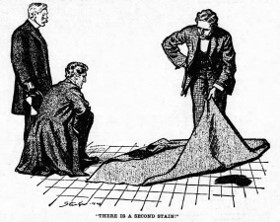
Perhaps a careful study of Watson’s use of noun stain in the title will reveal what it was that Holmes observes, and what others have completely missed. As noted above, many prominent scholars have found dating the case difficult, yet others have concentrated on the “out of character” behavior of the detective. Very few discussions have centered on the significance of the stain in the title. Remember that Holmes has stated, “There is nothing more deceptive than an obvious fact,”6 and the literal stains found on the rug, and the corresponding stain on the floor, are in fact the same stain. If this is so, then where is the second stain of the title? Like the three servants being mentioned as “both,” the purported two stains are but one stain. Thus, an examination of the varied meanings for the word stain may well be a good starting point.  


A physical stain, such as the rug and the floor, can be removed through the use of soap, or a chemical cleaner. It is more likely that Watson’s title refers to a permanent stain that cannot be erased. Is it a mere coincidence that Holmes remarks “Now, Watson, the fair sex is your department,” said Holmes, with a smile, when the dwindling frou-frou of skirts had ended in the slam of the front door. “What was the fair lady’s game? What did she really want?” What did Holmes observe that Watson did not? Watson’s lengthy description of Lady Hope’s physical appearance is consistent with all of his Canonical descriptions of the ladies, but he did not observe.  Following the departure of Lady Hope from their quarters, Holmes departs for 16 Godolfin Street alone. Why did he not invite Watson? 


A careful study of the types of stains may well explain why Holmes went alone. The Oxford English Dictionary7takes three pages to define the word stain. Yet, It is definition one: “the action of staining, pollution, disgrace,” that reveals this mysterious state of being unclean. This would be the case of Cain who slew his brother Abel. Ironically, in his discussion with God, Cain protests that if banished, others might kill him. As much as God loved Abel, he decides to protect Cain by stating: “‘15 In that case, whoever kills Cain will suffer vengeance seven times over.’ And He placed a mark on Cain so that whoever found him would not kill him.”8 This mark was a brand, a stigma, a stain — a symbol of his disgrace. It cannot be removed. 


There is also the case of Shakespeare’s Macbeth. As the play unfolds, the audience observes Lady Macbeth whose ambition has driven her to cajole her husband into murdering King Duncan to purloin the throne of Scotland. Her ambition has led to sleepless nights as she wrestles with her conscious, imagining the stain of her sin, something that no mortal can wash away.9 The behavior of Lady Macbeth, and her infamous nocturnal admission: “Out, damned spot! out, I say!” reveals a stain that is only present in her own mind. This is what Holmes observes in Lady Hope–her fear of being discovered. Having first judged her character, he suspects that someone has forced her to steal the document, and knowing Eduardo Lucas is involved, he deduces that she is somehow tied to him. 


Watson notes the stunning presence of Lady Hilda Trelawney Hope, yet Holmes observes something quite unique. He discovers that in her mind, she has committed not one but two sins. The first was the indiscretion that led to her being blackmailed by Eduardo Lucas in the first place. The second was taking the letter to Lucas to save her marriage. She did not realize that her impulsive act to save her marriage will destroy her husband. Holmes’s concern for Lady Hope would tend to indicate that the narrative must have taken place after Holmes returned from the Great Hiatus in 1891, because before this time he was not concerned with how his results will affect the lives of those involved. This would quantify Bell’s third theorem, SECO III,10on the dating of the case as the correct version of this adventure. Bell places the date of the case that was published as occurring in the year 1894 — post-hiatus. 


Lady Hope has intimate secrets that she has kept from her husband. Will she share these secrets with her husband? “‘Take your husband into your confidence.’ he tells her.” To which she pleads she cannot. It makes one wonder what types of secrets these young Victorian/Edwardian women write in these letters? Lady Hope’s offense was “an indiscreet letter written before my marriage—a foolish letter, a letter of an impulsive, loving girl.” It is hard to imagine that the man she came to love would throw her out for something that happened long before their marriage. Read Watson’s detailed description of her. I would dare say Watson would have kept her if she had written these letters the night before the wedding. However, we have her word on it: “For his own honour stands so high that he could not forget or pardon a lapse in another.” This view of her husband would tend to indicate that the title may well relate to her husband’s arrogance, pride, and his refusal to forgive her for “a foolish letter, a letter of an impulsive, loving girl.” Lady Hope admits what she did was foolish, but it is not a crime, nor a sin to be foolish. The sin is all in her own mind.  


It would appear that Lady Hope would be better off without such an unforgiving man, but Holmes realizes that his wife is the source of Hope’s backbone. Without her he is the sniveling, anxious man who first visited Holmes at Baker street. She is a woman of action, though sometimes too impulsive. She is honest to a fault. It is clear that Sherlock Holmes has determined that saving Lady Hilda Trelawney Hope’s reputation and her marriage is more important than the discovery of who murdered Eduardo Lucas. Lucas is a blackmailer and an international spy. Contrary to what some may suggest, allowing the official force to sort out who killed him is not new behavior for Sherlock Holmes. In “The Adventure of Charles Augustus Milverton,” Holmes reacts in the same manner as he remarks to Lestrade:  


“I knew this fellow Milverton, that I considered him one of the most dangerous men in London, and that I think there are certain crimes which the law cannot touch, and which therefore, to some extent, justify private revenge. No, it's no use arguing. I have made up my mind. My sympathies are with the criminals rather than with the victim, and I will not handle this case.”  


It is evident that contrary to what one sees in the narrative, one observes that Sherlock Holmes knew what he was doing every step of the way. The only evident mistakes are those were made by those who overlooked the obvious facts. 


End Notes 

1. Strong’s Hebrew Dictionary: a primitive root; properly, to carve or engrave, i.e. (by implication) to inscribe indelibly:--mark. 

2. Bell, H. W., Sherlock Holmes and Dr. Watson: The Chronology of Their Adventures, New York: The Baker Street Irregulars, 1953. 

3. Boucher, Anthony. in “From the Editor’s Commonplace Book,” BSJ (os) 2:1 (January 1947) pp. 60—61. 

4. “no one”: retrieved from The Miriam-Webster online dictionary

5. Roberts, Aubrey C. “The Real Second Stain: A Tarnished Idol, The Baker Street Journal, ed. Peter Blau, 32:4 (December 1982) p. 227. 

6. “The Boscombe Valley Mystery” 

7. The Compact Edition of The Oxford English Dictionary, vol. II, Oxford, England: Oxford UP,  May 1979, pp. 774-6. 

8. The Holy Bible, “Genesis 4" 

9. Jeremiah 2:22. “Even if you wash with lye and use a great amount of soap, the stain of your sin is still in front of Me.” 

10. Bell, p. 78. 

Thursday, December 23, 2021

A Second Look at "The Second Stain" by Rich Krisciunas

A Second Look at "The Second Stain" by Rich Krisciunas

After the public’s reaction to Sherlock Holmes’ death in "The Final Problem," Conan Doyle didn’t dare kill him off again, but he made a slight move towards ending the stories by retiring the detective to raise bees in Sussex Downs. At this point in his career, Conan Doyle was one of the world's highest-paid authors. For the six stories that would appear in the book The Return of Sherlock Holmes he had received $25,000 from the American magazine Collier's Weekly, and £100 per thousand words from The Strand.  


The last story in that book was “The Second Stain,” a story of murder, international spies, and blackmail.  It was first published in The Strand Magazine, December 1904 and Collier’s Weekly, January 28, 1905. For chronologists the story is thought to have occurred in the late 1880’s but Watson tells us he must be vague on the details of dates for reasons the public will understand and can only say that it began “on a Tuesday in autumn.” Baring-Gould sets the story in October 1886, while others like Historical Sherlock set it in 1888.

The story begins at a familiar Canonical place with Holmes and Watson together at Baker Street. Unlike earlier stories where Holmes is bored or reads Watson’s thoughts or makes deductions based on a client’s clothing, our story begins immediately with the arrival of two important people from the British government, Prime Minister Lord Bellinger and Trelawney Hope, Secretary for Foreign Affairs. 


Some scholars have guessed that the potentate was Kaiser Wilhelm of Germany. Holmes learns that if the information in the letter is revealed it could start a world war! Hope feels the letter is so important that he can’t leave it in a safe at his government office but has to bring it home. 

Hope last saw the letter at 7:30 pm. His wife, allegedly, went out and he went to bed after she returned at 11:30 p.m. so there is a four-hour window of opportunity for the thief.

After eliminating the household staff, who does Holmes first suspect as the possible thief?  Three international spies and secret agents, “… there are Oberstein, La Rothiere, and Eduardo Lucas.” Holmes plans to see each of them. But Watson tell Holmes that Lucas who lived near Hope’s home has been murdered last night. We’ll see Hugo Oberstein again in The Bruce-Partington Plans in His Last Bow.  As Holmes does on many occasions in the stories, we learn many details about the victim and the killing from a newspaper account.


The action stays at Baker Street. We haven’t left 221B yet as we get our first glimpse of Lady Hilda Trelawney Hope.  Lady Hilda wants Holmes to tell her the details of the missing letter. But, of course, Holmes cannot.  So she leaves and Holmes gives us one of his great lines. "Now, Watson, the fair sex is your department," said Holmes, with a smile, "What was the fair lady's game? What did she really want?"  

Holmes then tells us what he thinks about women.  “…the motives of women are so inscrutable. You remember the woman at Margate whom I suspected for the same reason. No powder on her nose—that proved to be the correct solution.”  For Holmes, Men are from Mars and women are from Venus. “Their most trivial action may mean volumes, or their most extraordinary conduct may depend upon a hairpin or a curling tongs." 


Does Holmes know women? Can he read their thoughts like he does with Watson or men?

Back to the story. I like to look at the structure of the stories. So far, we have met the three key characters; Bellinger, Hope and Lady Hilda. Where are we? Everything has occurred at 221B. This could be a script from a play. 

Two days pass and Holmes is lost in his thoughts. He smokes, runs in and out, visits the crime scene where Lucas was killed, plays his violin and munches on sandwiches. There has been a police investigation and a coroner’s inquest and Watson hasn’t left Baker Street during that entire time. “


What device does the author use to give us details of the status of the investigation?  In the Canon, some of the most important information and details don’t come to us from live characters we meet but rather, this critical information is provided through newspaper articles masquerading as characters. Conan Doyle uses this convenient vehicle in many stories to save time and fill in gaps as opposed to longer dialogue. Frequently, Holmes listens while Watson reads aloud a newspaper story providing details of a police investigation, a coroner’s inquest or the background of a person who has been murdered. 

There are at least 20 other examples of Holmes or Watson citing important information from newspaper articles in “the morning papers,” “the daily papers,” “the evening papers,” “the English papers,” “the society pages,” “the foreign papers” as well as advertisements in agony columns. Here, we learn that Lucas’ valet was initially arrested in relation to the murder but he had an alibi that cleared him.


After three mornings, Watson still hasn’t budged and the mysteries of the potentate’s letter and the murder remained unsolved. Another newspaper account provides us with more key details. As a former journalism major, I am amused by what the papers report: “Yesterday a lady, Mme. Henri Fournaye, was reported to the authorities by her servants as being insane.” Have you ever read such a story in your morning paper?

The police discovered that she was the wife of the murdered Lucas, who was leading a double life, and there is evidence to connect her with his killing.  “It is probable that the crime was either committed when insane, or that its immediate effect was to drive the unhappy woman out of her mind. … doctors hold out no hopes of reestablishment of her reason.” How these reporters get this medical information without making FOIA requests amazes me.

Note how Doyle’s writing reflects some 19th century stereotypes and prejudices of people of color who were considered to be more prone to emotional extremes than whites. The newspaper tells us: “Mme. Fournaye, who is of Creole origin, is of an extremely excitable nature, and has suffered in the past from attacks of jealousy which have amounted to frenzy.” 

So Holmes decides he has to revisit the crime scene where Lucas was killed.  And our chronicler, Watson, finally gets to leave 221B.  The scene shifts to Lucas’ apartment where Lestrade tells Holmes there is a problem and points to an ugly, irregular blood stain upon the carpet in the center of the room. 


There is no stain on the white floor under the blood-stained carpet. The blood should have soaked through. Then, Lestrade points out a second stain on the white floor covered by a carpet that doesn’t have blood on it. Holmes figures it out. "Why, it is simple enough. The two stains did correspond, but the carpet has been turned round." But Lestrade asks by whom and why?

Out of curiosity, why didn’t Holmes spot that issue the first time he went there?

While Lestrade pressures poor constable MacPherson to confess that he let a woman into the house to view the scene, Holmes finds an empty secret compartment under the carpet. 

As Holmes leaves the house, he shows the constable Lady Hilda’s photograph. This confirms to Holmes that she was the woman who was at the scene after the killing of Lucas and Holmes has solved the case. Holmes reveals, “You will be relieved to hear that there will be no war, … Trelawney Hope will suffer no setback in his brilliant career, … that the Prime Minister will have no European complication.”

So far, the action has been at Baker Street, Baker Street, then, moved to Godolphin Street where Lucas was killed and now shifts to the home of Lady Hilda for the grand climax.   


Holmes confronts her : “I know of your visit to Eduardo Lucas, of your giving him this document, of your ingenious return to the room last night, and of the manner in which you took the letter from the hiding-place under the carpet."

Ultimately, she gives Holmes the letter. Holmes replaces it in the dispatch box and Lady Hilda returns it to the bedroom. Holmes then asks Trelawney Hope to make sure that the letter isn’t still in the dispatch box and it is! The prime minister, sensing something fishy, asks Holmes what really happened and the story ends as Holmes gives the clever response, “We also have our diplomatic secrets.”

Monday, November 22, 2021

November Meeting: The Abbey Grange


2021 ended with another delightful meeting as Sherlockians from the St. Louis area, across America, and three other countries met on Zoom to discuss "The Abbey Grange."

As usual, we started off with some news:

Elaine had a fun post on our blog looking at what happens to people who fall in love in the Canon.

Anna Behrens has made some canonical connections to a local play, Trifles, on the blog as well.

The Crew of the Barque Lone Star has their latest collection, Holmes and Me, available on their website.

Our dates for 2022 are listed below.  The January meeting will be via Zoom, and the meetings past that will be TBD.

January 8: The Second Stain

March 19: The Valley of Fear

May 14: Wisteria Lodge

July 9: The Red Circle

September 10: The Bruce-Partington Plans

November 12: The Dying Detective


Brad announced the return of The Dangling Prussian on Zoom for anyone who is looking for something to do on the night of the BSI dinner.  And Madeline announced that her podcast, Dynamics of a Podcast, will be recording a live episode the following day.

And last but definitely not least.... The Parallel Case is planning to put out a book next year!  We are planning on including articles from our old newsletter, The Parallelogram, and blog posts.  Look for more news next year.


This month's story starts off with that great line from Holmes, "The game is afoot!"

Holmes wakes Watson with these words and they are off on a case.  Ten minutes later, our duo is in a cab on their way to Charing Cross station through "the opalescent London reek."  Once they are on the train, Holmes explains to Watson their task via a telegram from Stanley Hopkins:

"My dear Mr. Holmes:

"I should be very glad of your immediate assistance in what promises to be a most remarkable case.  It is something quite in your line.  Except for releasing the lady I will see that everything is kept exactly as I have found it, but I beg you not to lose an instant, as it is difficult to leave Sir Eustance there."

This is Hopkins's last appearance in the Canon, all of them have been part of The Return stories.  Andrew pointed out that all of his stories were published in 1904.

Along the way, Holmes gets in a jab a Watson's writing style, saying he laments that Watson has written his cases up as stories instead of instructions.  Arianna said this line always makes her cringe when she comes across it.  Watson tells Holmes to write them himself, to which Holmes says he will someday.

Rob noted that when he was reading this story, he realized that the title of Holmes's promised writing was not "The Whole Art of Detection," but that phrase was used as a description instead of a title.  He blamed Lyndsay Faye's great pastiche from a few years back for confusing him.

When Holmes and Watson arrive at the crime scene, the Abbey Grange, Hopkins meets them at the door and tells them that the lady of the house has come to and told him everything.  She says that it was the Randall gang that committed last night's crime.  Hopkins still wants Holmes to hear her story.  

This led to a discussion on Hopkins with our group.  Even though the case is solved in Hopkins's eyes, Elaine thought that he felt bad for having Holmes come all the way out so he went through the motions of having him hear the story.  Sandy thought maybe he wanted Holmes to double check his work.  Brad wanted to know why Hopkins was so excited when he wrote the note; was it because he was such a fanboy of Holmes?  And Heather said she thinks that Hopkins is smarter than anyone gives him credit for and he seems to be the one at the Yard that Holmes has the most esteem for.

And Watson REALLY likes the look of Lady Brackenstall...  Stacey said it was worth counting how many times Holmes uses the word "beautiful" to describe her.   Heather said there should be a drinking game where you take a shot every time he comments on a woman's beauty, but Rob warned that it could lead to alcohol poisoning.  And Alisha wondered how many women in the Canon Watson doesn't refer to as being pretty, the number must be a small one!

The lady opens her story with telling them that her late husband was a drunken jerk.  And then rails against the British laws that prevented her from getting a divorce from him.  But now, let's actually talk about the dead man.

Lady Brackenstall was turning in for the night after 11 and was checking the windows.  The dining room was open and a large, elderly man climbed in.  Two younger men followed him.  When she tried to scream, the old man hit her and she was knocked out.  She awoke tied to a chair with a bell rope.

Sir Eustance heard the commotion and came downstairs with a cudgel.  He rushed them and the old man hit him in the head with a fireplace poker, causing her to pass out again.  When she came to, the three men had collected all of the silver and where drinking wine.  They left and once she could get the gag loose, she screamed for the servants.


Holmes turns to the lady's maid and asks her what she has to say.  Theresa says that she saw three men loitering earlier in the night, but thought nothing of it.  Later in the night, she heard the scream and came down to find Lady Brackenstall tied to a chair and Sir Eustance dead.  She then told the investigators that they had asked enough of her lady, and took her away.

Hopkins tells Holmes that the maid has been with Lady Brackenstall since she was a baby and that they came over from Australia 18 months ago.

Sherlock Holmes has no interest in this case right now.  Alisha pointed out that Holmes has his own morality and a terrible man being killed isn't something that bothers him too much.  Arianna said we see the same thing with Charles Augustus Milverton.  


They go into the study and Eustance Brackenstall lay dead from a head wound.  A bent poker is next to him.  Holmes notes that the elder Randall must have been very strong to bend a poker over a man's head.  Sonia wondered how a man's skull could bend a metal poker.  Paul offered that since England left the UK, their standards of production have really gone downhill.  Michael wanted everyone to know that Paul delivered that information with a poker face.  Joe thought that Holmes knew quickly something was wrong because a gang would have definitely taken more than just the silverware.  Alisha agreed that none of Lady Brackenstall's story made sense.

Holmes wonders how the gang knew that no one in the house would hear when they pulled on the bell rope to tie the lady.  There were also only a few things taken from the sideboard.  Hopkins says that the robbers were too shaken by the man's death to do more.  But Holmes wonders why they stayed to drink the wine.  And Hopkins says it was to steady their nerves.

There were three glasses of wine left.  Only one of them had dregs of beeswing.  And now Holmes is suddenly interested in this case.


Holmes ends up taking Lady Brackenstall at her word, but is still troubled by the wine glasses, saying, "Perhaps when a man has special knowledge and special powers like my own, it rather encourages him to seek a complex explanation when a simple one is at hand."

Holmes and Watson leave, but Holmes is still puzzled on the way home, going so far as to jump off the train and go back to Abbey Grange.  "Every instinct that I possess cries out against it.  It's wrong - I'll swear that it's wrong."


Holmes sits Watson down, hoping he will be a conductor of light as he goes over the case.  The thieves had just made a good haul a few days ago, so they should be lying low.  They broke in earlier in the night than would be expected and thieves don't usually hit women as it makes them scream.  And why would they murder Sir Eustance when they had a three to one advantage over them?  And why didn't they finish drinking the wine?  

And speaking of wine: beeswing was in only one glass.  Watson says it's because it was the last glass poured.  Holmes says that all three glasses should have the beeswing.  But since that's not what they saw, the dregs of two glasses were actually poured into the third glass, proving Lady Brackenstall and her maid lied.

This led to conversation on Petri wine and plenty of people had thoughts on its taste and how scary it would be to drink.  Steve had a bottle at home and threatened to make everyone drink it.  Bill told about The Occupants of the Empty House tried a bottle one time and everyone spit it back out!  Susan remembered the Occupants publishing a series of articles on Petri wine as well.


Holmes and Watson return to Abbey Grange.  Hopkins is gone so Holmes investigates the dining room for two hours, paying close attention to the broken rope.  And there is also blood splattered on the chair where Lady Brackenstall had apparently been tied up when her husband was murdered.

Stacey really appreciated Watson's description of the Brackenstall dining room and getting to watch Holmes work step-by-step through the investigative process, saying it made this story one of her favorites.  Adam said there are a lot of readers who love to see the process.

They talk to Theresa and Lady Brackenstall, asking specifically for the truth.  The women stick to their stories.  On the way out, Holmes notices that the pond has a hole broken in the ice.  He sends a note to Hopkins and they visit the Adelaide-South Hampton shipping line.


There the two learn about Jack Croker (or Crocker in the American text) and they take a cab to Scotland Yard.  Holmes rethinks things, sends another telegram, and they go home.  Holmes tells Watson that he couldn't tell the police.  "I had rather play tricks with the law of England than with my own conscience."

Sandy thought that Holmes wanted to be the judge of the culprit before he was turned over to the law.  And Joe noted that the wife would automatically be included if he had turned Croker in.

Hopkins arrives at Baker Street and says he followed Holmes's suggestion and found the stolen silver in the pond, making his case harder.  And on top if it all, the Randall gang has been arrested in America this morning!  Holmes wishes Hopkins the best, and we do not see him again in any more stories.


After dinner, Captain Croker arrives and tells Holmes to do what he will with him.  But Holmes says, "I should not sit here smoking with you if I thought that you were a common criminal, you may be sure of that.  Be frank with me, and we may do some good.  Play tricks with me, and I'll crush you."

Sherlock Holmes is determined to hear the truth from someone involved in this matter.

Croker tells his story that he fell in love with Lady Brackenstall before she was married, when she sailed on his ship from Australia.  He recently ran in to Theresa, and she updated him on how miserable the Lady's life was now.  He started visiting her when Eustance was away, and made one last visit last night when Eustance came down and caught them.  He called his wife "the vilest name that a man could use to a woman," and hit her in the face before he and Croker fought.

Sonia said Croker's story of falling in love sounded obsessive.  Stacey pointed out that Watson told the readers how good-looking Croker was.  And Brad pointed out that even the corpse was good-looking as well.


Rob admitted that he was getting this story mixed up with "The Crooked Man" and expected Sir Eustance to hit his head on the mantle instead of being killed by Croker.

Croker and Theresa set up the whole charade and convinced Lady Brackenstall to go along with it.  He tells Holmes to do what he will with this information.  Holmes smokes for a minute and then shakes Croker's hand, telling him that this will all come out but Holmes will not stop him from leaving on his ship.  Croker gets mad that Lady Brackenstall will be tied to all of this as an accomplice and asks Holmes to arrange it where he takes all of the blame and leaves her out of it completely.


Holmes shakes the man's hand a second time, telling him that he has passed the test.  Holmes won't tell anyone about it and asks Watson to play the role of a British jury, saying, "I never met a man who was more eminently fitted to represent one."  Quite a nice change from his comments on Watson's writing at the beginning of the story!

Watson announces Croker not guilty, and Holmes says that as long as the murder isn't pinned on an innocent man, Croker can come back to Lady Brackenstall in a year and they can live happily ever after.

D. Martin Dakin noted that this story was published seven years after it took place, and the culprits could still be charged, which made him think that the lovers had died by the story's publication date.  Stacey offered that they could have moved to Australia and disappeared into the Outback.  This led us to a detour talking about all of the times Australia popped up in the Canon.

Stacey wanted to talk about how predatory Sir Eustance was and how quickly he married Mary after meeting her.  Sonia wondered if Mary was a gold-digger and she was the one who sped the marriage.  Rob said Brackenstall could've had a title and Mary had the money, creating a situation similar to The Noble Bachelor.  Kevin thought Eustance laid on the charm and then revealed his true colors after they were married.  Rich pointed out that he didn't set any dogs on fire until after the marriage.

And that's a wrap for The Parallel Case of St. Louis meetings in 2021!  Make sure to follow us on Facebook and Twitter to stay up-to-date on our happenings and other Sherlockian news.  See you in 2022!

Friday, November 19, 2021

There is Nothing So Important as Trifles by Anna Behrens

There is Nothing So Important as Trifles by Anna Behrens, MA, CCC-SLP

Recently I had the opportunity to watch an engaging film version of the one-act play Trifles, by Susan Glaspell. The performance was by a local play group called the Edge Ensemble, and happens to star my talented mother-in-law. So, what, if anything, could this play about a woman apparently having murdered her abusive husband have to do with Sherlock Holmes? 


In a serendipitous juxtaposition, I watched in the same evening as Trifles, the Granada Television adaptation of The Abbey Grange (ABBE) because I was creating a presentation on the story for my scion group, The Monadnock Sherlockians. After viewing both films, I had a fitful night of sleep, but I awoke with a feeling of clarity, where I realized that Trifles was in large part a re-telling of the ABBE story! 

For those unfamiliar with Trifles, I recommend the Edge Ensemble’s version on YouTube. It is a fine adaptation that sticks very closely to the original script. The play is out of copyright, and is available to read online as well. It is often studied in feminist studies college courses, and was published 12 years after ABBE. Because Arthur Conan Doyle was the most famous author of his day, and Susan Glaspell a budding journalist and writer, it is a fair assumption that Glaspell was more than somewhat familiar with his Sherlock Holmes stories. 

An obvious clue to the comparison is in the name of the play itself, Trifles, as in Holmes’ mantra “there is nothing so important as trifles.” In fact, Holmes’ success in solving crimes is largely based on his observation of trifles. And trifles ignored by the police are the very thing that lead the protagonist, Mrs. Hale, more in the guise of Miss Marple than Sherlock, to her secret conclusions about the murder of Mr. John Wright.

Mrs. Peters, the Sheriff’s wife who came to the Wright farmhouse to gather clothing for jailed Mrs. Wright, then, is Glaspell’s Watson. Mrs. Peters doesn't see the deeper meaning behind the trifles that Mrs. Hale does until Mrs. Hale enlightens her. Mrs. Peters, like Watson, tends to take things at face value, standing in for the reader or audience member.   

The County Attorney, Sheriff Peters, and Mr. Hale represent Inspector Lestrade of Scotland Yard or the police force that Holmes typically eclipses. While they go about pursuing the case using traditional methods, they clearly don't have Mrs. Hale's unique skills, so they miss the important clues. They diminish the women's skills as Scotland Yard often downplays Holmes' methods, until they are forced to admit his supremacy. In Trifles, Mrs. Hale does not reveal her superior methods to them, leaving them in the dark, as Holmes has also been known to do. Mr. Hale says dismissively in Trifles, “Well, women are used to worrying over trifles”.

The following similarities are too close to be dismissed as coincidence, and are what led me to the connection between the story and the play. There is an abused wife in both ABBE and Trifles. The husband’s killing of his wife’s beloved bird in Trifles parallels the husband’s killing of his wife’s beloved dog in ABBE.  Margaret Wright is the abused wife in Trifles who does not admit to her crime, and Theresa Wright is the lady’s maid in ABBE who tells of abuse her lady suffered at the hands of her husband and lies to help protect her. 


Mrs. Hale and Holmes use clues (trifles) missed by police as evidence to solve the crime such as the broken bird cage, the dead bird, and the poor stitching in Trifles and the cut bell rope, the bloodstain, and sediment in only one of three wine glasses in ABBE.

Mrs. Hale's sleuthing shows Wright to be the actual perpetrator of crimes against his wife that are unlikely to have been punished, let alone acknowledged, in the patriarchal society they lived in. This is also the case in ABBE, where the abused wife could not seek divorce from her abusive husband, nor have the law against him for his abuse. 

The wives share the initials MF, Minnie Foster in Trifles and Mary Brackenstall (nee Fraser) in ABBE.  And although the characters are not parallel, JW first name and initials are shared by John Watson and the murdered John Wright. 

In both stories, there is justifiable homicide due to abuse suffered by victims, according to Sherlock Holmes and Mrs. Hale, and supported by Watson and Mrs. Peters. In ABBE, Holmes takes the law into his own hands and appoints Watson the jury, while he himself is the judge, and they let Jack Crocker go free. Holmes justifies it by using the Latin phrase Vox Populi, Vox Dei (the voice of the people is the voice of God).

By staying silent and hiding the evidence of the dead bird, Mrs. Hale takes the law into her own hands as she deduces that Mrs. Wright is guilty of murdering her husband, but that she is justified because of the psychological abuse she suffered at his hands. As Susan Glaspell’s title of her short story version of her play indicates, Mrs. Hale and Mrs. Peters, much like Holmes and Watson, appoint themselves “a jury of her peers.”

Susan Glaspell masterfully used key elements in ABBE to fictionalize the true crime of a murdered husband that she reported on as a journalist. By embodying Holmes and Watson in two housewives, Glaspell penned a feminist masterpiece that is still relevant and taught in feminist studies courses today, more than 100 years after it was first published. Irene Adler would, no doubt, approve.